
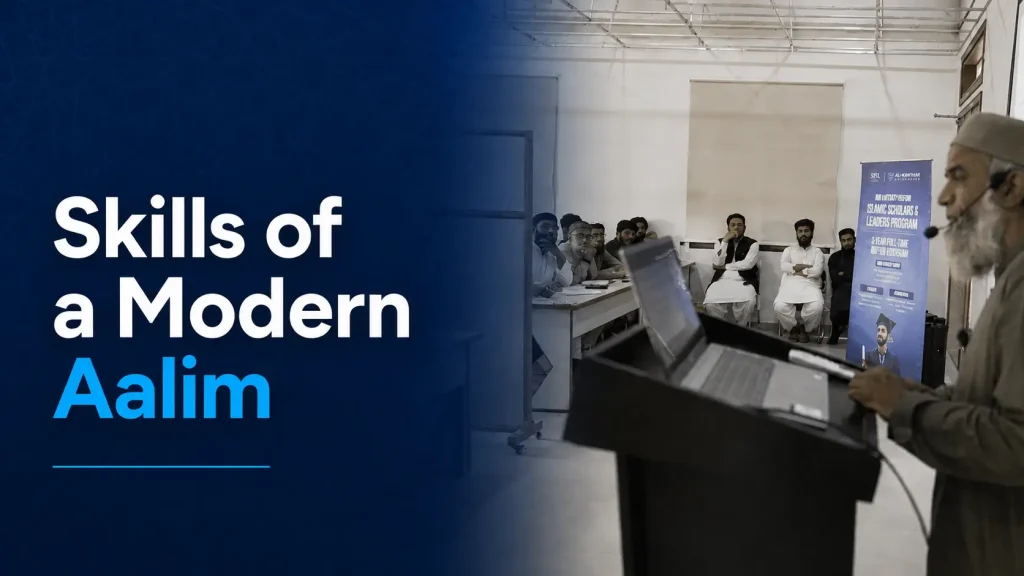
The essential skills of a modern Aalim include strong grounding in classical Islamic scholarship along with clear communication, research, writing, leadership, and technology literacy. These skills support the study of Arabic, Fiqh, Hadith, and Tafsir by helping scholars explain complex ideas clearly, research contemporary questions carefully, work with other professionals, and guide communities more effectively.
A university student comes to you with doubts about faith. A working professional wants guidance on whether a new financial product aligns with Islamic principles. Someone else is trying to make sense of an argument they encountered online. Each situation requires you to understand the question clearly, identify the relevant Islamic principles, and explain them in language the person can use.
An Aalim needs a strong command of Arabic, Fiqh, Tafsir, Hadith, and the wider Islamic scholarly tradition. Alongside that knowledge, you need the ability to explain ideas clearly, research unfamiliar issues carefully, write for different audiences, lead responsibly, and use technology without letting it replace scholarship.
The Qur’an places wisdom and good instruction at the heart of how knowledge is conveyed:
“Invite to the way of your Lord with wisdom and good instruction, and argue with them in a way that is best.” – (Surah An-Nahl 16:125)
Your Aalim course gives you the scholarly foundation needed to understand Islamic teachings in depth. The skills you develop alongside that education shape how you research new questions, speak to different audiences, work with other professionals, and guide the communities you serve.
This guide looks at the skills a modern Aalim needs beyond core scholarship, including communication, research, writing, critical reading, leadership, technology literacy, collaboration, and awareness of the institutions and challenges people deal with in everyday life.
Classical Scholarship Comes First
Before communication, technology, or leadership skills enter the picture, an Aalim needs a strong grounding in the Islamic sciences.
Arabic gives you access to the language of the Qur’an and much of the classical scholarly tradition. Tafsir, Hadith, Fiqh, Usul al-Fiqh, Aqeedah, and related disciplines then teach you how generations of scholars understood, preserved, discussed, and taught Islamic knowledge.
These additional skills build on that education. They help you research new questions, communicate what you have learned, and work with people whose situations may involve fields outside your own training.
A strong scholarly foundation usually includes:
- Arabic Language:
Sarf, Nahw, and Balaghah develop the ability to work through increasingly advanced classical texts.
- Tafsir:
You study Quranic commentary alongside principles that help you understand language, context, and scholarly interpretation.
- Hadith:
You engage with major Hadith works, terminology, commentary, and the methods scholars use when studying transmission.
- Fiqh and Usul al-Fiqh:
You learn established rulings while also studying the principles behind Islamic legal reasoning.
- Aqeedah and Supporting Disciplines:
These subjects deepen your understanding of Islamic belief, reasoning, and the wider scholarly tradition.
Arabic becomes especially important when a small grammatical detail changes the meaning of an argument or passage. A closer look at what an Aalim studies also shows how these disciplines develop over several years.
Communication That People Can Understand
Knowing the answer is only part of guiding someone. You also need to understand what they’re asking and explain the relevant Islamic principles in language they can follow.
One day, you may be speaking to teenagers about faith and identity. Another conversation may involve a business owner asking about a contract, parents seeking guidance about their children, or university students working through intellectual doubts.
Using the same vocabulary and level of detail with every audience rarely works.
Explaining Complex Ideas Clearly
Islamic scholarship contains technical terms because technical language gives scholars precision. Terms such as Gharar, Maslahah, Qiyas, and Ijtihad often need more than a direct English translation. When speaking to a wider audience, your task is to explain the idea without losing the meaning.
Ali ibn Abi Talib (may Allah be pleased with him) said:
“Speak to people according to what they understand. Do you wish that Allah and His Messenger be denied?” – (Sahih al-Bukhari 127)
Good communication therefore means knowing what your audience already understands, where they are confused, and how much information will genuinely help them.
Aisha (may Allah be pleased with her) also described the speech of Prophet Muhammad (PBUH):
“The Messenger of Allah (PBUH) spoke in a distinct manner so that anyone who listened to him could understand it.” – (Sunan Abi Dawud 4839)
Clarity doesn’t require oversimplifying Islamic knowledge. It requires presenting the right amount of information in a way that helps the person understand it correctly.
Listening Before You Answer
Scholars often receive questions about:
- Marriage
- Finances
- Family disagreements
- Grief
- Personal struggles
- Religious doubts.
Active listening helps you notice when someone is asking a different question from the one they first stated. It also helps you identify when an issue involves emotional, medical, legal, or psychological factors that require input from another professional.
The Dars-e-Nizami curriculum grounds you in Islamic scholarship, while communication and listening skills help you use that knowledge responsibly with the people who approach you.
Research, Writing, and Critical Reading
A modern Aalim encounters information from far more sources than printed Islamic texts:
- Academic papers
- Government policies
- Financial documents
- Medical research
- News reports
- Social media arguments
- AI-generated material
All these resources may become relevant to the questions people ask. Research skills help you work through that information without accepting every claim at face value.
Research and Source Evaluation
When researching a religious question, you may need to verify:
- A Hadith reference
- Locate a discussion in a Fiqh text
- Compare scholarly positions
- Check whether a quotation circulating online appears in the attributed source.
Contemporary questions may require another layer. A question about cryptocurrency, for example, requires an accurate understanding of how the financial product works before any relevant Islamic legal principles are considered.
Research, then, means more than finding Islamic sources. It also requires understanding the subject being discussed.
Writing for Different Audiences
Writing also forms an important part of contemporary scholarship.
You may need to prepare:
- An educational article for general readers.
- A research paper for an academic audience.
- Notes for a lecture or Khutbah.
- A written response to a community question.
- Educational material for students.
- Research explaining an Islamic perspective on a contemporary issue.
Each format asks something different from you. Academic writing may require detailed references and engagement with existing research, while public-facing writing needs clear explanations that don’t assume the reader already knows specialist terminology.
This is one reason university Islamic Studies can add useful research and academic writing skills to traditional textual study.
Reading Contemporary Arguments Carefully
A scholar also needs to understand the arguments people encounter outside Islamic institutions.
Questions about:
- Materialism
- Ethics
- Feminism
- Economics
- Secularism
- Artificial intelligence
- Sexuality
- Politics
- Personal identity
Often reach young Muslims through universities, workplaces, podcasts, and social media. Responding responsibly requires more than hearing a short description of an idea and immediately criticizing it.
You need to understand what its proponents actually argue, identify the assumptions behind it, and then engage with those claims through Islamic knowledge and careful reasoning.
Technology Literacy and Digital Research
Technology now affects how Islamic knowledge is researched, taught, published, and consumed.
Using digital tools responsibly can make research and teaching more efficient, but those tools should never replace scholarship or verification.
Using Digital Libraries
Searchable libraries give you faster access to large collections of Tafsir, Hadith, Fiqh, biographies, and other classical works.
A scholar who understands these platforms may locate references, compare passages, search for terminology across multiple texts, and trace discussions that would otherwise require far more manual searching.
Speed still doesn’t remove the need to check context. Finding a sentence through a keyword search isn’t the same as understanding the discussion surrounding it.
Using AI With Care
AI tools introduce another layer to scholarly research. They may help you locate possible references, organize large amounts of information, compare themes, or identify sources worth investigating.
Their outputs still need verification because generated answers can misquote a source, miss the context, combine unrelated material, or give an incorrect reference.
A scholar using AI needs enough subject knowledge to recognize when an answer looks questionable and enough research discipline to return to the original source.
Teaching and Communicating Online
Digital literacy also affects how scholars reach people.
Articles, podcasts, recorded lessons, webinars, short-form videos, and online classes allow Islamic education to reach audiences far beyond a local mosque or institution.
Each format brings its own responsibilities. Short content needs particular care because complex religious discussions can lose important context when they are reduced too aggressively.
Leadership and Working With Other Experts
An Aalim may eventually lead:
- A school
- Islamic organization
- Mosque
- Research project
- Charity
- Community initiative.
Scholarship is essential, but managing people and institutions also requires practical skills that are learned through experience, training, and good counsel.
Leadership requires planning, accountability, communication, decision-making, and the ability to work with people whose expertise differs from your own.
Understanding How Institutions Work
Basic familiarity with governance, finances, employment responsibilities, safeguarding, organizational policies, and legal requirements helps scholars work more responsibly within institutions.
You do not need to become an accountant or lawyer. You need enough understanding to recognize when a decision requires professional expertise and who should be involved.
Collaborating Across Different Fields
Many contemporary Islamic questions sit at the intersection of several disciplines.
A medical ethics question may require a doctor to explain the procedure before a scholar examines its Islamic implications. A fintech question may require a financial specialist who understands the product.
Questions involving artificial intelligence may require technical expertise before their ethical consequences are assessed properly.
Collaboration helps you understand the facts of a case before applying your own scholarly expertise.
Managing Disagreement
Leadership also requires dealing with disagreement without allowing every difference to become a conflict.
You may work with teachers, administrators, parents, community members, researchers, and other scholars who approach a problem differently. Listening carefully, identifying the actual point of disagreement, and communicating decisions clearly often determines whether a team remains productive.
Knowing the Limits of Your Role
One of the most valuable skills a scholar develops is the ability to recognize when a question falls outside their level of training.
An Aalim receives broad education across the Islamic sciences, while some areas require further specialization. Formal Ifta is one example.
| An Aalim May Commonly | A Mufti Specializes Further In |
| Teach Qur’an, Hadith, Fiqh, and other Islamic subjects | Detailed Fiqh and Ifta research |
| Explain established religious guidance | Research formal fatwas |
| Provide community education and mentorship | Examine complex cases where details affect the ruling |
| Refer specialized questions when needed | Apply advanced legal training to specific cases |
Knowing the difference between an Aalim and a Mufti helps you understand why referring a question to someone more specialized reflects scholarly responsibility rather than a lack of knowledge.
The same principle applies outside religious specialization. A scholar dealing with a medical, financial, legal, or psychological question should involve relevant professionals when the facts require expertise beyond Islamic studies.
Skills of a Modern Aalim: A Practical Checklist
Classical knowledge remains the foundation. The additional skills below help you research, teach, communicate, and lead more effectively.
| Skill | Why It Matters |
| Classical Arabic | Gives you deeper access to Qur’an, Hadith, Fiqh, Tafsir, and classical scholarship |
| Communication | Helps you explain difficult ideas to different audiences |
| Listening | Helps you understand the question before giving guidance |
| Research | Helps you verify sources and investigate contemporary issues carefully |
| Writing | Allows you to contribute through articles, educational material, and academic work |
| Critical Reading | Helps you assess arguments, claims, and information before responding |
| Technology Literacy | Helps you use digital libraries, research tools, and online platforms responsibly |
| Leadership | Helps you manage people, projects, and community responsibilities |
| Collaboration | Helps you work with specialists when a question crosses into another field |
| Self-Awareness | Helps you recognize where your knowledge ends and when to refer someone elsewhere |
These abilities develop gradually. A student starting Aalim studies after Matric does not need to have every skill already in place. Years of scholar training provide opportunities to improve them alongside Islamic studies.
A similar principle applies to students coming from Hifz. The journey from Hafiz to Aalim begins with a valuable Quranic foundation and then expands into Arabic, research, Islamic sciences, communication, and broader scholarly development.
Developing Modern Scholar Skills at SISL
SISL’s Islamic Scholar & Leaders Program approaches scholar education through both classical Islamic study and wider academic development.
Across the eight-year program, students pursue Dars-e-Nizami alongside university Islamic Studies while also developing research, communication, critical thinking, leadership, and technology-related skills.
The aim is to help you build a strong scholarly foundation while learning how to engage with people, institutions, and questions beyond a traditional Islamic studies setting.
Digital research also forms part of that environment. SISL initiatives such as Ilmverse.ai expose students to new ways of locating and organizing Islamic source material while keeping scholarly verification central to the research process.
Those additional skills become especially useful when you look at the wider career options after becoming an Aalim. Scholars may work in education, research, community leadership, writing, Islamic finance, media, or other fields where clear communication and interdisciplinary understanding matter.
Your development may also continue well beyond general scholar training. Depending on your interests, study after an Aalim course may take you into Ifta, Hadith, Tafsir, postgraduate university education, research, or another area of specialization.
Carrying Knowledge With Understanding and Responsibility
Islamic scholarship carries a responsibility that extends beyond acquiring information. What you learn needs to be understood carefully, communicated accurately, and applied within the limits of your knowledge.
Prophet Muhammad (PBUH) said:
“The scholars are the inheritors of the Prophets. The Prophets did not leave behind dinars or dirhams, but they left behind knowledge.” – (Sunan Abi Dawud 3641)
The skills of a modern Aalim support that responsibility in practical ways. Communication helps people understand you. Research helps you investigate unfamiliar questions. Technology gives you access to sources and audiences that earlier generations reached differently. Leadership and collaboration help you serve people without assuming expertise you do not possess.
For students pursuing scholar training at SISL, these abilities develop alongside Dars-e-Nizami and university Islamic Studies. The goal remains rooted in scholarship: understand the tradition deeply, know the people you are speaking to, and bring Islamic knowledge to the questions they are actually asking.
Frequently Asked Questions
Does an Aalim need technology skills?
Yes. Basic digital literacy helps with research, teaching, source retrieval, communication, and responsible use of emerging tools such as AI.
Should an Aalim learn public speaking?
Strong speaking skills help an Aalim teach, deliver lectures, answer questions, and explain Islamic ideas clearly to different audiences.
Why are research skills important for an Aalim?
Research skills help you verify references, understand new issues accurately, compare sources, and avoid relying on weak or misleading information.
Does learning modern skills replace Dars-e-Nizami?
No. Communication, research, leadership, and technology support classical scholar training rather than replacing Arabic, Tafsir, Hadith, Fiqh, Usul, or other Islamic sciences.
Can an Aalim work outside a mosque or madrasa?
Yes. Depending on additional qualifications and experience, Aalims may work in education, research, writing, Islamic finance, community organizations, media, and other fields.
