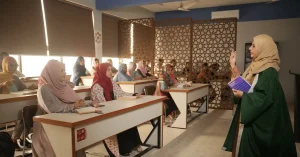
Dars-e-Nizami is a traditional Islamic curriculum developed in 18th-century South Asia to train students in the core disciplines of Islamic scholarship. It covers Arabic language and linguistics, logic (Mantiq), Quranic exegesis (Tafsir), Hadith, jurisprudence (Fiqh), and legal theory (Usul al-Fiqh). Its primary aim is to develop the skills needed to read, understand, and analyze classical Islamic texts independently.
If you’ve explored formal Islamic scholarship in any South Asian country, you’ve likely come across the term “Dars-e-Nizami”. It refers to a traditional curriculum followed by Islamic seminaries to prepare students for advanced study of the Qur’an, Hadith, Fiqh, Arabic, and other core Islamic sciences.
For many students, understanding Dars-e-Nizami is the first step toward understanding what formal Islamic scholarship actually involves. Prophet Muhammad (PBUH) highlighted the value of seeking and preserving knowledge:
“Indeed, the scholars are the inheritors of the Prophets. The Prophets did not leave behind dinars or dirhams, but they left behind knowledge, and whoever takes it has taken a bountiful share.” – (Jami` at-Tirmidhi 2682)
Whether you’re exploring a comprehensive Aalim course or simply want to understand how Dars-e-Nizami works, this guide covers its origins, key subjects, academic purpose, and place in modern Islamic education.
What Is Dars-e-Nizami?
The term “Dars-e-Nizami” comes from dars, meaning lesson or study, and Nizami, referring to Mulla Nizamuddin Sihalawi, the scholar associated with developing the curriculum at Farangi Mahal in Lucknow.
Over time, Dars-e-Nizami became widely adopted across Islamic seminaries in South Asia, although the subjects, books, and length of study may differ from one institution to another.
Its purpose is to prepare students to engage with classical Islamic scholarship directly. Students develop a strong command of Arabic and study disciplines such as grammar, logic, Fiqh, Usul al-Fiqh, Tafsir, and Hadith, gradually building the skills required to understand and teach advanced Islamic texts.
The Origins and Historical Evolution of Dars-e-Nizami
Dars-e-Nizami developed in the early 18th century around Farangi Mahal in Lucknow, where Mulla Nizamuddin Sihalawi became one of the leading scholars of his generation.
His curriculum brought together Islamic sciences with subjects such as logic, philosophy, Arabic grammar, and legal theory. It later influenced seminary education across much of South Asia.
Farangi Mahal itself began as a scholarly household. Students travelled to study with the family members, and the curriculum gained wider influence as their scholarly network grew. The need to develop knowledgeable scholars also reflects a wider responsibility mentioned in the Qur’an:
“And it is not for the believers to go forth [to battle] all at once. For there should separate from every division of them a group [to obtain] understanding in the religion and warn their people when they return to them that they might be cautious.” – (Surah At-Tawbah 9:122)
How the Dars-e-Nizami Curriculum Builds Knowledge
A major feature of Dars-e-Nizami is the way different subjects prepare students for deeper study.
Arabic, logic, and rhetoric develop the skills needed to work through classical texts, while Tafsir, Hadith, Fiqh, and other Islamic sciences form the main areas of scholarly study.
| Foundational disciplines | Core Islamic sciences |
| Sarf: Arabic morphology and word formation | Tafsir: Study and interpretation of the Qur’an |
| Nahw: Arabic grammar and sentence construction | Hadith: Study of Prophetic narrations and their transmission |
| Balaghah: Rhetoric and expression in classical Arabic | Fiqh: Study of Islamic rulings and jurisprudence |
| Mantiq: Logic and methods of reasoning | Usul al-Fiqh: Principles used in Islamic legal reasoning |
Students begin by developing the tools needed to understand what they’re reading.
Sarf and Nahw, for example, help students recognise how Arabic words and sentences work, making mastery of classical Arabic a central part of progressing into advanced Islamic texts.
Balaghah develops an understanding of rhetoric and expression, while Mantiq introduces methods of reasoning used throughout the scholarly tradition.
As students progress, those foundations support deeper engagement with Tafsir, Hadith, Fiqh, and Usul al-Fiqh.
Rather than approaching each subject separately, students gradually learn how language, interpretation, evidence, and legal reasoning connect across Islamic scholarship.
Core Subjects and Academic Progression
Dars-e-Nizami becomes more demanding as students develop the skills needed to work with advanced Islamic texts.
Early study usually places greater emphasis on Arabic language, grammar, introductory Fiqh, and other foundations. Later years introduce deeper work in Usul al-Fiqh, Tafsir, Hadith, Balaghah, Mantiq, and advanced jurisprudence.
As students progress, what an Aalim studies becomes more advanced, moving from Arabic foundations and introductory Fiqh toward Tafsir, Hadith, Usul al-Fiqh, and deeper engagement with classical texts.
The exact order varies between seminaries, but a typical progression looks broadly like this:
| Stage of Study | Main Areas of Focus | What the Student Develops |
| Foundation | Sarf, Nahw, Arabic, introductory Fiqh | Ability to understand Arabic grammar and begin reading classical texts |
| Intermediate | Balaghah, Mantiq, Fiqh, Usul al-Fiqh | Stronger reasoning, interpretation, and engagement with scholarly texts |
| Advanced | Tafsir, advanced Fiqh, Aqeedah, Hadith sciences | Deeper analysis of Qur’anic commentary, jurisprudence, and Hadith |
| Dawrah-e-Hadith | Sahih al-Bukhari, Sahih Muslim, Sunan works, and other major Hadith collections | Intensive study of major Hadith texts under qualified scholars |
Many South Asian programs conclude with Dawrah-e-Hadith, during which students study major Hadith collections closely with their teachers. The duration and arrangement of Dars-e-Nizami differ between institutions, so students should look at the curriculum of the seminary they’re considering rather than assuming every program follows the same timetable.
Those differences also affect the timeline for scholar training, particularly for students starting scholar studies after matriculation.
How SISL Combines Dars-e-Nizami with University Education
If you’re considering Dars-e-Nizami, you may also be thinking about where university education fits into years of formal scholar training.
SISL brings both paths together through its eight-year Islamic Scholar & Leaders Program, where students pursue traditional Islamic scholarship alongside university studies in Islamic Studies.
| Dars-e-Nizami Studies | University Education at SISL |
| Arabic, Fiqh, Tafsir, Hadith, and Usul | BS and MS in Islamic Studies |
| Study of classical Islamic texts | Academic research and writing |
| Traditional scholar training and Sanad pathway | HEC-recognized degree pathway |
| Focus on Islamic legal and scholarly disciplines | Critical thinking, communication, and research skills |
| Preparation for advanced Islamic scholarship | Preparation for further study and professional work |
Board Examination and HEC Equivalence
Seminary education follows its own examination and certification system through recognized Deeni boards.
Qualifications such as Shahadatul Almiya Fil Uloomal Arabia wal Islamia, when awarded by HEC-approved Deeni institutions and completed according to HEC requirements, receive equivalence to an MA in Arabic or Islamic Studies for teaching these subjects and pursuing higher studies.
For someone planning years of Islamic scholarship, understanding that academic pathway matters. It helps you see how traditional qualifications fit within Pakistan’s wider education system and what options remain open once your scholar training is complete.
The Integrated Model at SISL
At SISL, Dars-e-Nizami and university education run alongside each other throughout the Islamic Scholar & Leaders Program.
You continue studying the classical disciplines expected from formal scholar training while developing the academic and professional skills needed for further education, research, and public engagement.
- Islamic Scholarship:
Students study Dars-e-Nizami and work toward traditional Sanad certification through sustained study of Arabic, Fiqh, Tafsir, Hadith, Usul, and related disciplines.
- University Education:
Islamic Studies at the university level adds academic research, writing, and broader engagement with contemporary questions to the student’s education.
- Research and Leadership:
Communication, critical thinking, leadership, and technology form part of the wider learning experience, helping students engage with people and questions beyond the seminary setting.
Students comparing scholar training with academic Islamic Studies degree tracks will notice important differences in how each path approaches classical texts, Arabic, Fiqh, Hadith, research, and academic study.
How Islamic Scholarship Addresses New Challenges
Studying Fiqh, Usul al-Fiqh, Hadith, and other classical disciplines gives you a framework for examining questions that continue to emerge in Muslim communities.
As those questions change, scholars need enough depth in the tradition to understand the principles involved before applying them to a new context.
- Islamic Banking and Finance:
Knowledge of Fiqh al-Mu‘amalat and legal principles helps scholars examine financial contracts, business practices, Islamic banking products, and emerging fintech models.
- Bioethics and Governance:
Developments in medicine, technology, and public policy raise questions that require careful engagement with Islamic legal principles and relevant subject experts.
- Education and Mentorship:
Scholars may teach in schools, universities, Islamic institutions, community programs, or online spaces where they need to explain complex ideas clearly to people with very different levels of Islamic knowledge.
For a Hafiz, the transition from Quran memorization to scholarship builds on years already spent memorizing and revising the Qur’an while introducing deeper study of Arabic, Tafsir, Hadith, Fiqh, and other Islamic sciences.
As students progress, the contemporary skills required for modern scholarship become increasingly relevant to how they research, communicate, teach, and engage with new questions.
Those abilities also broaden the career pathways available to graduates, while students who want to deepen their specialization may pursue advanced study options after graduation.
Dars-e-Nizami and Further Specialization
Completing Dars-e-Nizami gives you a broad foundation across the main Islamic sciences, including Arabic, Fiqh, Tafsir, Hadith, Aqeedah, and Usul al-Fiqh.
Over years of study, you develop the language skills needed to read classical Arabic texts, follow scholarly arguments, and understand how different areas of Islamic scholarship connect with one another.
What Dars-e-Nizami Prepares You For
By the end of Dars-e-Nizami, you’ve studied across a wide range of disciplines. That range prepares you for teaching, research, community guidance, and further study while also helping you identify the areas you may want to explore in greater depth.
As your studies progress, you also become familiar with the way classical scholars approached questions of interpretation, evidence, jurisprudence, and religious guidance.
That foundation becomes especially important if you decide to continue into a specialized field after completing your general scholar training.
What Takhassus fi al-Ifta Adds
If you want to specialize in Islamic law and formal religious rulings, you may continue into Takhassus fi al-Ifta.
At this stage, your studies go deeper into Fiqh, Usul al-Fiqh, legal research, fatwa writing, and the application of established scholarly principles to specific cases. You learn how to examine the details that may affect a ruling, locate relevant discussions in classical sources, compare scholarly positions, understand the reasoning behind those positions, and present an answer with the level of care required in formal Ifta.
| After Dars-e-Nizami | During Mufti Specialization |
| You study broadly across the main Islamic sciences | You focus more deeply on Fiqh and Ifta |
| You build knowledge of Arabic, Tafsir, Hadith, Fiqh, Aqeedah, and Usul | You examine complex legal questions in greater depth |
| You develop the ability to work with classical texts | You develop advanced legal research and fatwa-writing skills |
| You build a foundation for teaching, research, and further study | You learn how legal principles apply to specific cases |
| You complete general scholar training | You continue into specialized legal study |
Why the Difference Matters
The difference between an Aalim and a Mufti becomes clearer when you look at what happens after general scholar training.
As an Aalim, you study broadly across the Islamic sciences. If you continue toward becoming a Mufti, your focus narrows toward advanced jurisprudence, legal research, and the process of issuing formal religious rulings.
A general understanding of Islamic law doesn’t carry the same responsibility as issuing a fatwa. When you enter Ifta training, you’re expected to examine legal texts, scholarly precedent, relevant circumstances, and the details of each case with far greater depth before reaching a conclusion.
Where Dars-e-Nizami Can Take You
Understanding Dars-e-Nizami gives you a clearer picture of what formal Islamic scholarship asks of you: years of Arabic, Fiqh, Tafsir, Hadith, Usul, and close study under qualified teachers. The value of that journey lies in the depth you build and the responsibility that comes with carrying Islamic knowledge forward.
At SISL, Dars-e-Nizami forms part of the Islamic Scholar & Leaders Program, where traditional scholar training runs alongside university education, research, communication, leadership, and contemporary academic skills.
The aim is to help you develop the depth required for classical scholarship while preparing you to engage thoughtfully with the questions Muslims face across education, research, communities, and professional life.
If you’re considering formal Islamic scholarship, think beyond how long the journey takes and ask what kind of scholar you want to become. The path you choose should give you the knowledge, judgement, and academic grounding to study Islam deeply and serve people responsibly.
Frequently Asked Questions
What does the name Dars-e-Nizami mean?
Dars means lesson or study, while Nizami refers to Mulla Nizamuddin Sihalawi, the scholar associated with developing the curriculum at Farangi Mahal in Lucknow.
Is Dars-e-Nizami taught only in South Asia?
No. It originated in South Asia but is also taught in Islamic institutions across the UK, South Africa, North America, and other regions.
Do all seminaries teach the exact same books?
No. Most programs cover similar core disciplines, but the books, sequence, and duration vary between institutions.
Can you study Dars-e-Nizami alongside a university degree?
Yes. SISL’s Islamic Scholar & Leaders Program combines Dars-e-Nizami with university education in Islamic Studies.
What is the difference between Dars-e-Nizami and a university Islamic Studies degree?
Dars-e-Nizami focuses more deeply on Arabic, classical texts, Fiqh, Hadith, Tafsir, and Usul. University Islamic Studies usually places greater emphasis on academic research, history, and contemporary analysis.